

| Keyword | Description |
|---|---|
| Tamaulipas | A large state on the border with the U.S. |
| Karst window | A natural opening in a cave environment that allows light to enter, creating distinct habitats. |
| Cx50 gene | A gene related to lens formation in the eye, whose mutation can lead to blindness. |
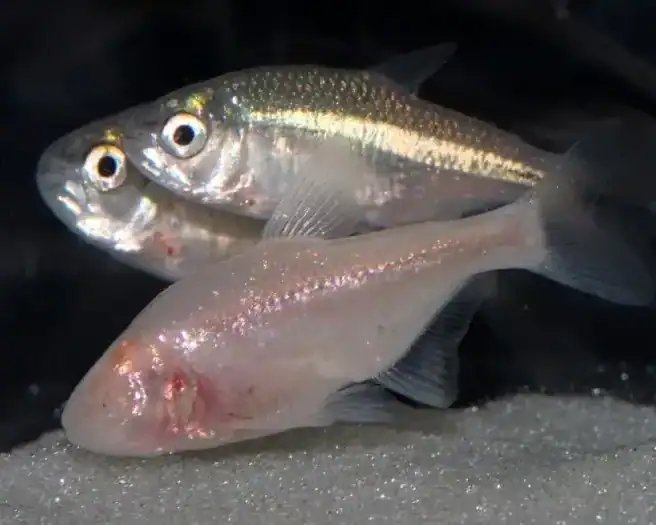
In a remarkable discovery, scientists have studied a unique cave ecosystem in the mountains of Tamaulipas, Mexico. This ecosystem features Mexican tetra fish with full vision living alongside their blind relatives. The location, known as Caballo Moro, is part of a limestone cave system near the El Cielo Biosphere Reserve.
Thousands of years ago, a part of the cave ceiling collapsed, creating a “karst window” — which allowed light into a specific section of an 80-meter-long pool. This has resulted in two separate habitats: one lit, where sighted Mexican tetras thrive, and one dark, dominated by blind cavefish.
The study, published on bioRxiv, reveals this side-by-side living arrangement has become a natural laboratory for researchers to explore the evolution of blindness in cave environments. While past research identified about 35 populations of blind or nearly blind Mexican tetras, the genetic causes of this blindness were not fully understood.
By comparing the DNA of sighted and blind fish, scientists identified 203 significant mutations across 41 genes, with a particular focus on the Cx50 gene. This gene is crucial for eye development, and disabling it in normally sighted fish caused rapid degeneration of their eyes.
The research also suggests that the sighted fish in Caballo Moro are descendants of surface fish that entered the cave 3,300 to 4,300 generations ago, interbreeding with the blind fish. This has resulted in a population with both fully sighted and completely blind individuals.
Interestingly, the sighted fish remain aggressive and territorial in the illuminated areas, using their vision to defend against their blind counterparts. Similar mutations in eye-related genes have been observed in other cavefish and underground mammals, suggesting a common evolutionary path toward blindness in dark environments.
Bridging words
These words sound similar in English and Spanish: Why not practice them now?
| English | Spanish |
|---|---|
| Generation | Generación |
| Mutation | Mutación |
| Biology | Biología |
Time to discuss
- What might be the advantages and disadvantages of having sight in a cave environment?
- Why do you think evolution led to the development of blind fish in these caves?
- How do genetic mutations like those in the Cx50 gene affect evolution?
Let’s Write
Answer the following questions in one paragraph
- Explain how the “karst window” affects the fish populations in Caballo Moro.
- Discuss the significance of the Cx50 gene in the study of cavefish evolution.

