

| Keywords | Description |
|---|---|
| High-speed Corridors | Dedicated train track routes built to accommodate high-speed passenger traffic. |
| International Bidding | A process where a government invites companies from all over the world to submit competing offers to build a project for the best price. |
| Arterial Vision | A big-picture plan to build main transport lines — like major blood vessels — that act as the core spine connecting major regions together. |
The Mexican government is advancing its ambitious passenger rail program with the launch of its second construction phase, aiming to connect central Mexico to the Pacific Coast and northern regions via high-speed corridors. Efraín Deschamps Gutiérrez de Velasco, head of works at the Agency for Trains and Integrated Public Transportation (Attrapi), announced that foundational technical studies for this phase are complete.
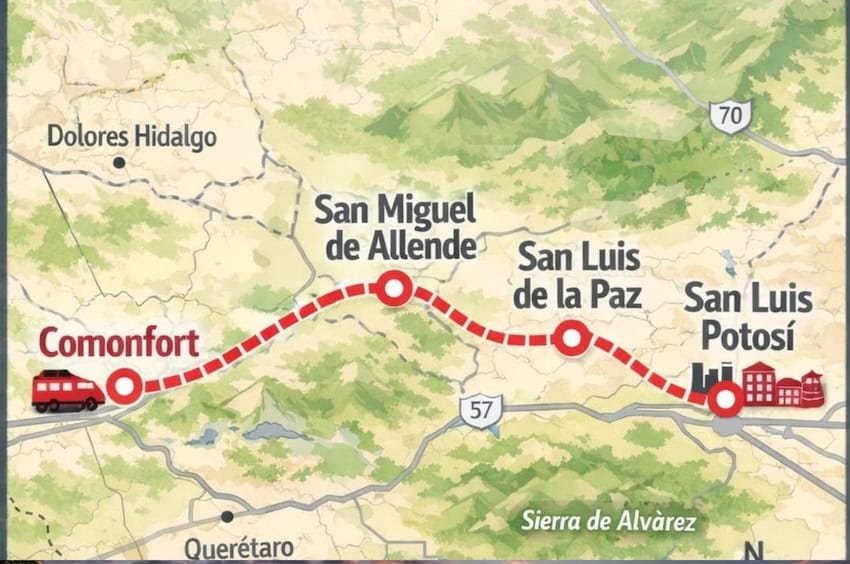
Work in this second phase will focus on the Irapuato-León and León-Guadalajara routes. These projects will be managed by the Felipe Ángeles Engineering Group, the military division responsible for constructing Felipe Ángeles International Airport near Mexico City. The agency has also opened international bidding for the first segment of the Querétaro-San Luis Potosí route. This 68-kilometer stretch between Querétaro and San Miguel de Allende is scheduled to break ground Sept. 24.
The bidding process and plans for future expansion
Bidding for the San Luis Potosí-Saltillo segment will proceed in phases through September. Meanwhile, the Mazatlán-Los Mochis segment remains in pre-investment review, awaiting final regulatory approval. The Querétaro-San Luis Potosí route forms part of a broader arterial vision connecting Mexico City to Nuevo Laredo.
A planned third phase will expand high-speed transit along 1,100 kilometers of the Pacific corridor, linking Guadalajara, Tepic, Mazatlán, Los Mochis, Guaymas and Hermosillo. A fourth phase aims to extend service to Nogales at the U.S. border. Designed for speeds of 160 to 200 kilometers per hour, these lines will serve passengers exclusively, operating independently of freight traffic.
Bridging words
These words sound similar in English and Spanish: Why not practice them now?
| English | Spanish |
|---|---|
| Ambitious | Ambicioso |
| Phase | Fase |
| Potential | Potencial |
Time to discuss
- What are the benefits of expanding high-speed rail systems in a country?
- How might these new rail lines impact local economies in Mexico?
- Why is international bidding important for large infrastructure projects?
Let’s Write
Answer the following questions in one paragraph:
- Describe the potential challenges of constructing high-speed rail lines in Mexico.
- What role does the Felipe Ángeles Engineering Group play in this project?

